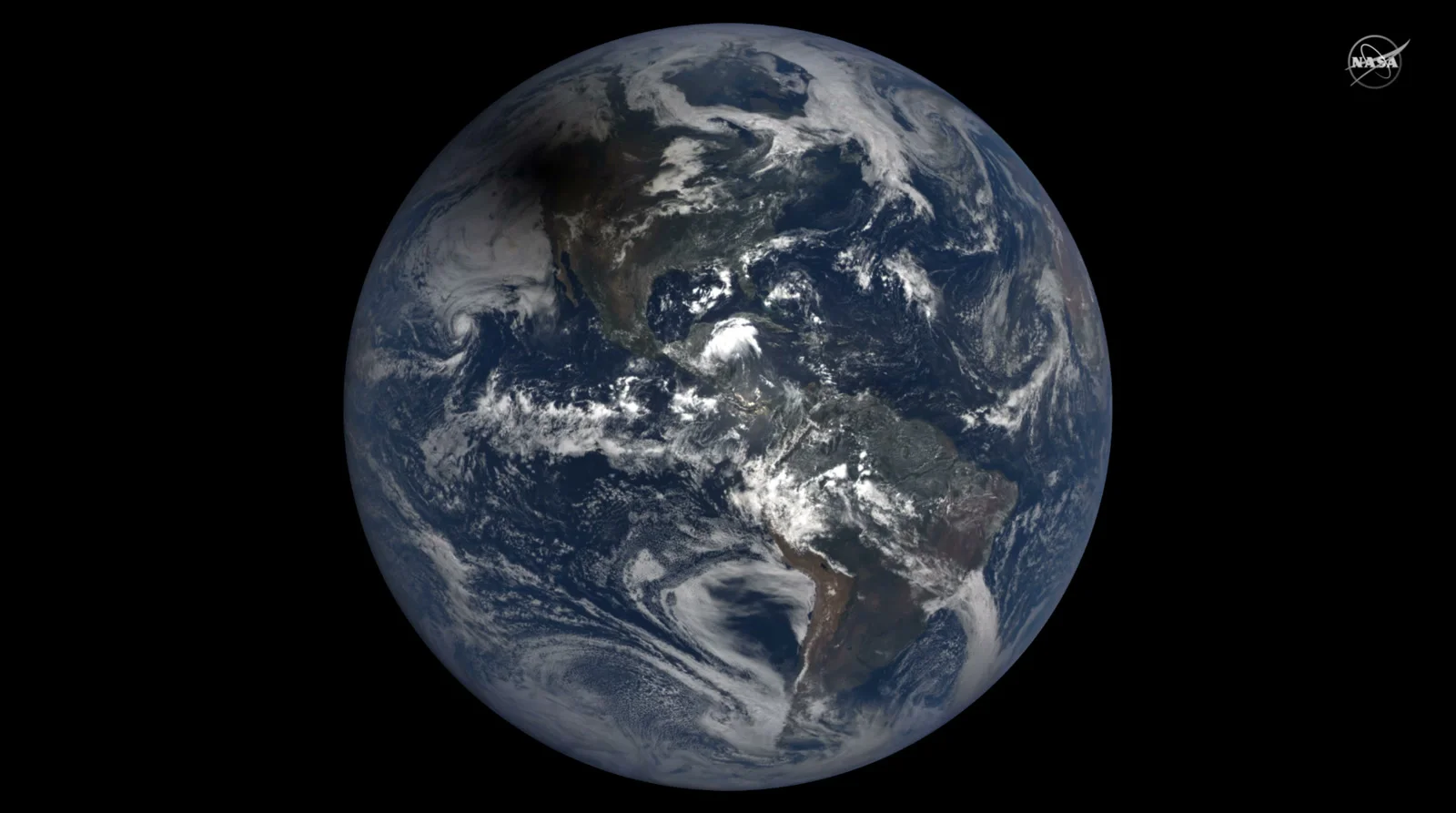
An eclipse can have a close relative 18 years later without returning to your town. The Saros cycle repeats much of the Moon's alignment and distance, but the Earth underneath has turned. To see the next member of the family, you usually need a new destination.
Three lunar cycles almost meet again
New Moon is necessary for a solar eclipse, but it is not enough. The Moon's orbital plane is tilted by about 5.1° to Earth's orbital plane. Usually its shadow misses Earth. An eclipse needs New Moon near one of the two nodes, where those planes intersect.
A similar eclipse also needs a similar Earth–Moon distance. That changes the Moon's apparent size and helps determine whether a central eclipse is total or annular. Three different lunar periods therefore matter:
NASA — Lunar periods and eclipse recurrence
- Synodic month: about 29.53 days, from one New Moon to the next.
- Draconic month: about 27.21 days, from one passage through a node to the next passage through the same node.
- Anomalistic month: about 27.55 days, from one perigee, the Moon's closest approach to Earth, to the next.
What the 18-year interval actually repeats
After 223 synodic months, roughly 242 draconic months and 239 anomalistic months have also elapsed. These intervals differ by only a few hours. This near-match is the Saros: about 6,585.32 days, commonly described as 18 years, 11 days and eight hours. The calendar-day count varies with the leap days in the interval.
The Moon is new again, near the same node and at a similar distance from Earth. The event also falls at a similar time of year. That makes successive members useful for comparing eclipse geometry. It does not make their ground tracks or durations identical.
The remaining eight hours move the path west
A Saros is not a whole number of days. Its roughly one-third-day remainder allows Earth to rotate about another third of a turn. Consequently, the next eclipse path in the series lies roughly 120° farther west in longitude.
That is a global rule of thumb, not an instruction to slide an old map sideways. The alignment changes slightly too, so the path also shifts north or south. Its curvature, width and local duration need fresh calculations. A photograph from the previous member cannot tell you which hotel will be inside the next path.
NASA — Why successive paths shift west
Follow the 2027 eclipse through Saros 136
The total solar eclipse of 2 August 2027 belongs to Saros 136. NASA's catalogue lists these consecutive members: 11 July 1991, 22 July 2009, 2 August 2027 and 12 August 2045. Each step adds one Saros; it does not identify the next solar eclipse of any family.
The catalogue's coordinates at greatest eclipse make the change visible: 2009 is at about 24.2°N, 144.1°E; 2027 at 25.5°N, 33.2°E; and 2045 at 25.9°N, 78.5°W. Those are single reference points, not whole paths or recommended observing sites. Their longitude jumps are about 111°, illustrating why 120° is an approximation.
The table labels its greatest-eclipse times TD, a dynamical time scale. They are not local civil clock readings. Use a location-specific prediction and its stated time zone when planning attendance.
NASA — Saros 136 dates, coordinates and table notes
Why three Saros cycles can still miss your observing site
After three Saros cycles, the three roughly eight-hour remainders add up to about a day. The eclipse family returns to roughly the same longitude region after about 54 years and one month. This longer cycle is called the Exeligmos.
The lunar periods never line up exactly. Their small differences accumulate, moving the shadow relative to Earth's centre. Even a three-Saros return can miss a previous observing site. Over centuries a series changes character and eventually ends; its members are related events, not copies.
NASA — Exeligmos and the changing life of a series
Plan the event at your coordinates
Use the Saros to understand an eclipse's relatives. To choose a viewing place, select the actual event, check whether your coordinates are inside its total or annular path, then inspect local contact times and the Sun's altitude and direction. Verify buildings, trees, access and the real horizon separately.
For the 2 August 2027 total eclipse, open the planner and select that event before placing your pin. Keep the event's totality boundary separate from the much larger area that sees only a partial eclipse. The safety exception for unaided viewing applies only during complete totality at that pin.
Open the planner and select 2 August 2027
How eclipse maps become accurate