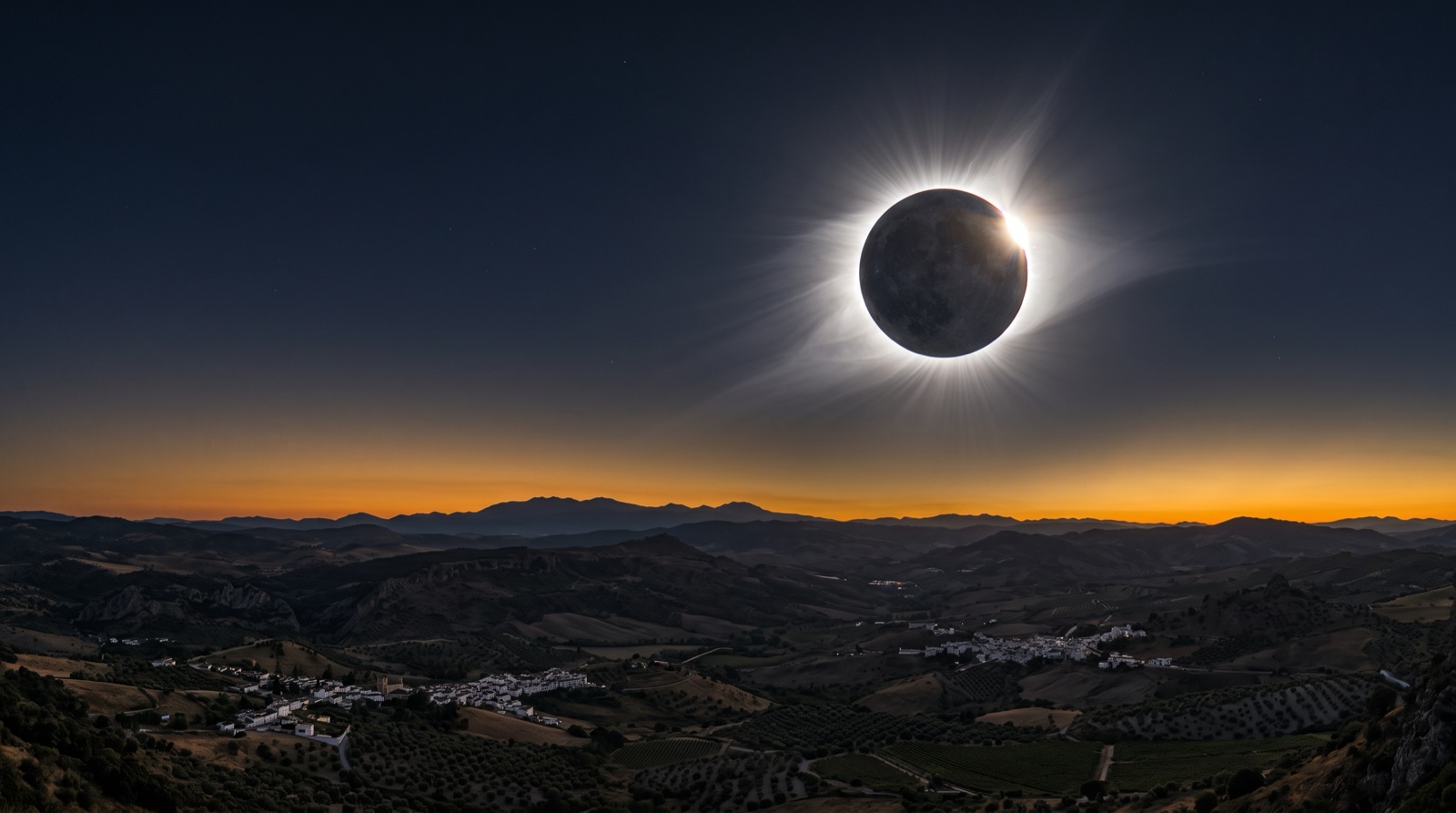
"C'est partiel à 99,9 %, c'est en gros une éclipse presque totale, n'est-ce pas ?" C’est l’idée fausse la plus répandue en astronomie amateur. En physique et en perception sensorielle humaine, une éclipse solaire partielle à 99,99 % est fondamentalement différente d'une éclipse solaire totale à 100 %.
1. Flux lumineux et intensité de la photosphère solaire
La photosphère visible est beaucoup plus lumineuse que la couronne solaire. Même un croissant très fin envoie encore assez de lumière directe et diffusée dans l'atmosphère pour dominer la scène et masquer la couronne.
Le changement le plus spectaculaire de la luminosité ambiante se produit pendant la dernière minute avant la totalité. Lorsque la photosphère disparaît, la lumière restante vient de la couronne et du paysage éclairé hors de l'ombre de la Lune.
2. Comment la vision humaine s'adapte (perception logarithmique)
L’œil humain ne perçoit pas la lumière de manière linéaire ; il ajuste le diamètre de la pupille et la sensibilité rétinienne de manière logarithmique. À mesure que la lumière du soleil diminue de 100 % à 1 % pendant les phases partielles, vos yeux s'ajustent continuellement, donnant l'impression que l'environnement est une journée légèrement nuageuse ou une paire de lunettes de soleil sombres.
Cependant, la transition finale vers la totalité est suffisamment rapide pour que les yeux ne puissent pas s’adapter complètement en temps réel :
La transition soudaine à 100 % de totalité :
De la lumière du jour au crépuscule soudain : La luminosité peut chuter rapidement pendant la dernière minute et atteindre des niveaux proches du crépuscule pendant la totalité ; l'aspect exact dépend du lieu et des conditions.
Baisse de température : Une baisse perceptible de température est possible, mais son ampleur varie selon la météo, le site et les conditions de l'éclipse.
Couronne solaire dévoilée : L’atmosphère éthérée et nacrée du Soleil devient visible à l’œil nu.
Coucher de soleil à 360° : Tout au long de votre horizon, vous voyez les bords lointains de la Terre à l’extérieur de l’ombre ombragée qui brille en orange au coucher du soleil.
3. Ce qui vous manque à 99,99 % partiel
Si vous restez à seulement 1 kilomètre en dehors du chemin de la totalité, vous ferez l’expérience :
- PAS de couronne solaire : vous ne pouvez pas regarder le soleil sans lunettes solaires.
- AUCUNE visibilité à l'œil nu : les lunettes de sécurité solaires doivent rester allumées à tout moment.
- PAS de protubérances ni de bague en diamant : l'atmosphère solaire reste cachée derrière les reflets.
"La différence entre une éclipse partielle à 99,99 % et une éclipse totale à 100 % ne se résume pas à 0,01 point de pourcentage : c'est la différence entre une photosphère brillante qui masque la couronne et une atmosphère solaire entièrement visible."
4. Utilisez SunEclipses pour garantir une totalité à 100 %
Ne manquez pas la totalité de quelques centaines de mètres. Utilisez SunEclipses Planner pour tester les coordonnées de votre observateur à l'intérieur du chemin ombral, estimer le timing de totalité spécifique à l'observateur et inspecter le dégagement du terrain DEM. Vérifier les résultats marginaux sur place.