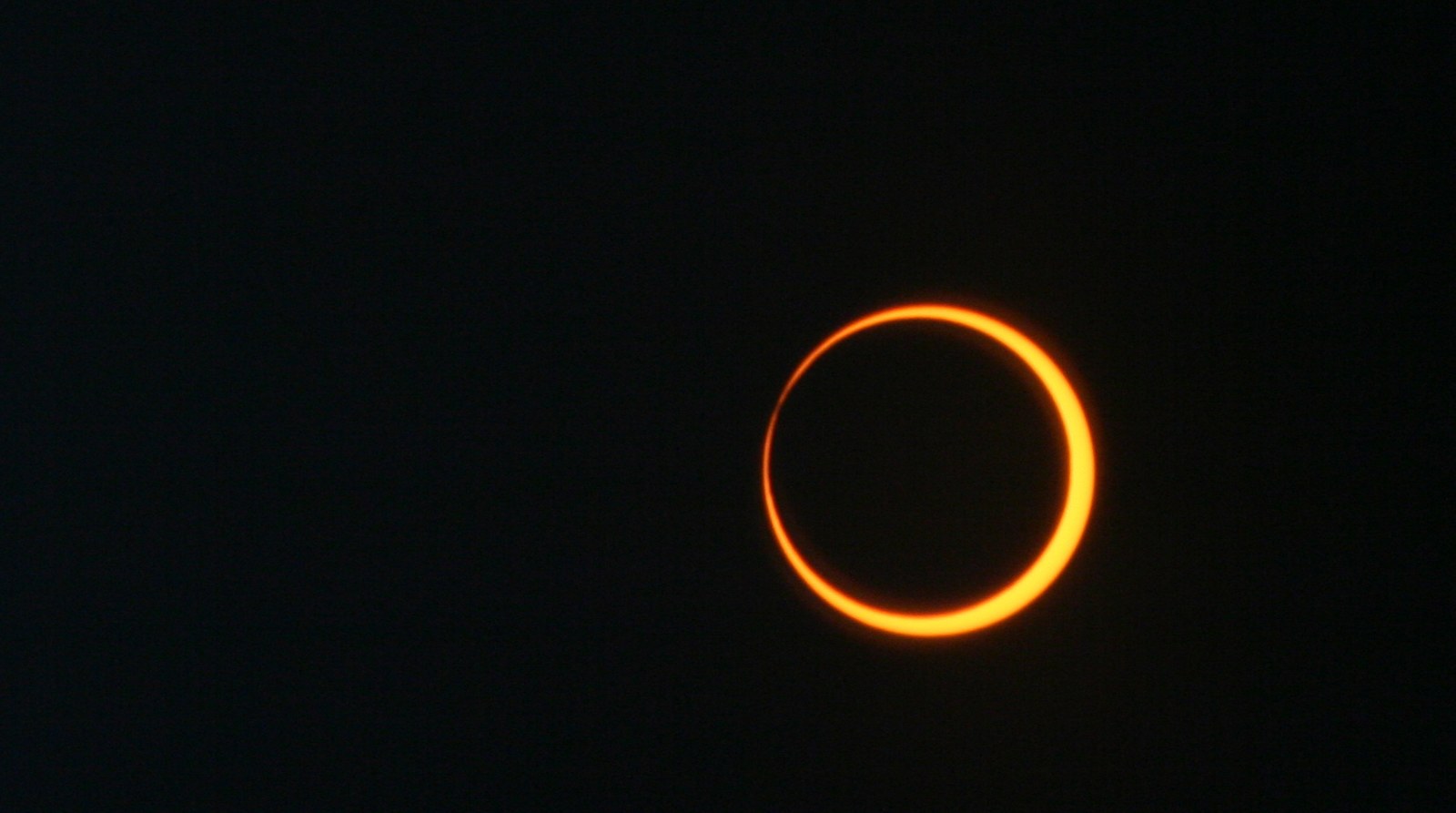
On Saturday 6 February 2027, annularity will be visible from parts of southern Chile, Argentina and southeast Uruguay. Compare the Chiloé area, Andean Patagonia, Argentina’s Atlantic coast and Uruguay’s southeast coast. Your observing coordinates must be inside the annular path; elsewhere in the wider visibility region, the eclipse will be partial.
Start with the annular path, then choose a destination
The February eclipse is a different event from the total eclipse of 2 August 2027. The Osiris astronomy group’s local guide identifies a route through southern Chile, Chubut and Río Negro, Argentina’s Buenos Aires province and southeast Uruguay. The complete event also extends across the oceans and toward Africa; this guide concentrates on South American land destinations.
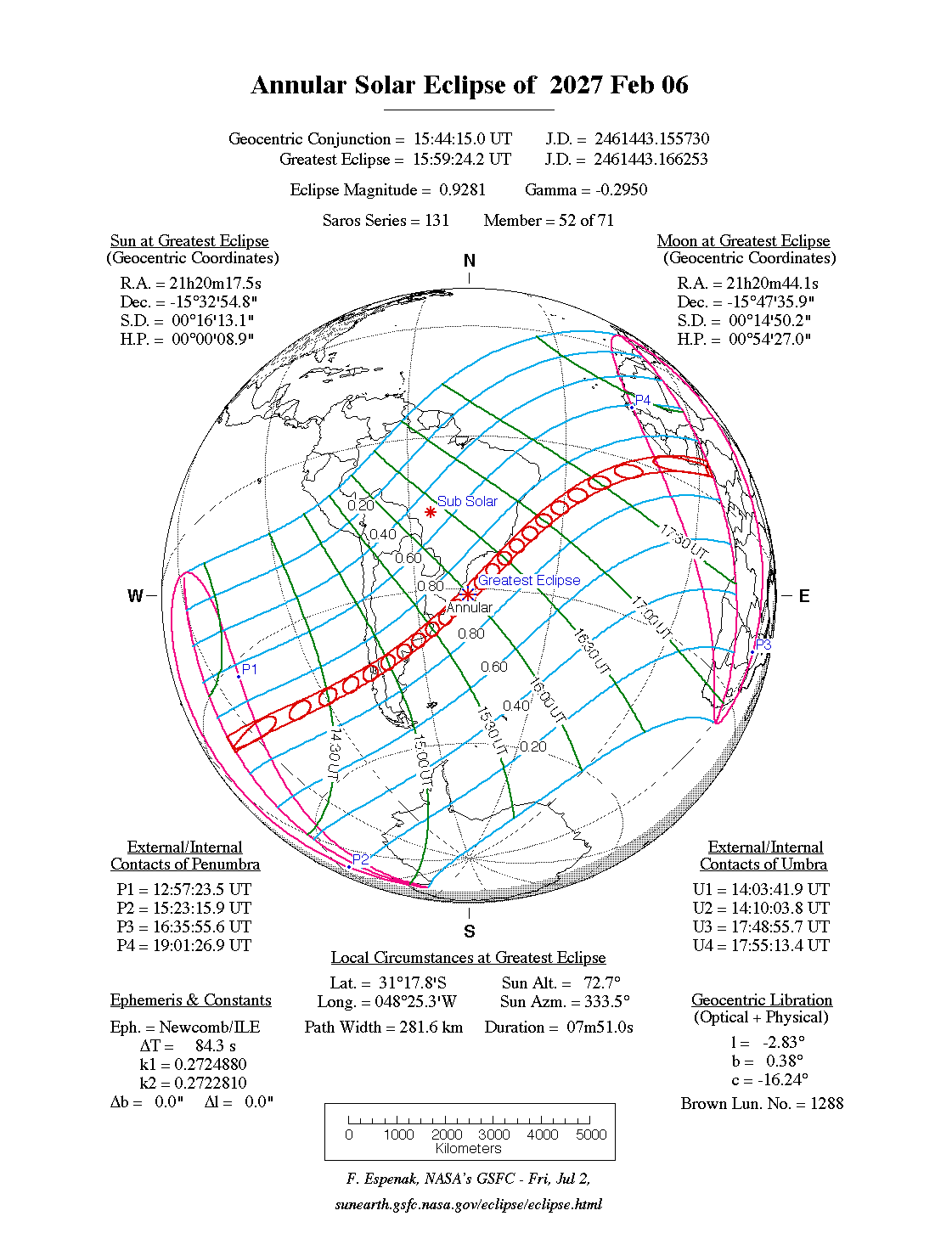
On the path map, find the two boundaries enclosing annularity and the centreline between them. Save the exact observing coordinates with your booking notes. Check the accommodation and observing site separately if they are in different places.
Osiris — February 2027 route and local viewing guidance
NASA/GSFC — path limits and centreline coordinates
Chile: compare individual sites around Chiloé
Castro and Quellón on Chiloé, and Chaitén on the mainland, appear in the Osiris list of annular-viewing towns. Treat these as candidates, not a promise that every point on Chiloé or across Los Lagos and Aysén sees the ring. The boundaries cut across regions; check the actual hotel, public viewing area or roadside viewpoint separately.
For an island or coastal itinerary, decide how much flexibility you need before reserving transport. Check whether a backup can be reached using the available roads or sailings, and whether its viewing land is accessible.
Osiris — Chilean and Argentine candidate towns
Argentina: choose between Andean and Atlantic candidates
For an Andean itinerary, the local guide lists Esquel, Trevelin and El Bolsón. Farther east, its candidates include Las Grutas, Viedma, Bahía Blanca and Mar del Plata. Check the exact coordinates of any beach or public viewing site you shortlist.
The Universidad Nacional de La Plata’s ETACAR eclipse page provides independently calculated circumstances for representative towns and a location calculator. Compare the length of annularity, the solar altitude and the start and end of the partial phases at each candidate. Then weigh those results against travel time and a comfortable, permitted place to stay for the whole eclipse.
ETACAR, Universidad Nacional de La Plata — local calculations and visibility
Osiris — Argentine viewing locations
Uruguay: investigate the southeast coast
Punta del Este and La Paloma are named by Osiris as places where annularity will be visible. Use them as starting points for a southeast-coast shortlist, rather than assuming the whole Uruguayan coast has the same view. An exact map check is particularly useful when comparing properties spread along the shore.
Osiris — Uruguay’s annular-viewing candidates
Read the duration and the clock correctly
NASA’s detailed path table distinguishes greatest eclipse from greatest duration. At greatest eclipse, near 31.3° south and 48.5° west in the Atlantic, annularity lasts about 7 minutes 51 seconds. The longest central duration in that table is about 7 minutes 54 seconds, at another Atlantic point. Neither is a duration promised for a city, and neither measures the full partial-to-partial event.
The same table uses Universal Time, labelled UT. ETACAR explicitly labels its tables in Argentina’s official time, UTC−3. A timestamp near 16:00 UT therefore means near 13:00 on that clock, not 16:00 local time. That example describes a time conversion, not the eclipse maximum at your hotel. Check each location’s own contacts and stated time zone, and reconfirm Chilean civil-time rules before travelling.
Do not plan from the boundary line alone. The NASA path table does not include the Moon’s mountains and valleys and notes that these can shift the predicted edges by roughly 1–3 kilometres. For a first annular eclipse, selecting a location comfortably inside the band avoids an unnecessary edge-of-path gamble.
NASA/GSFC — greatest eclipse, greatest duration and prediction limits
ETACAR — tables labelled in Argentina time, UTC−3
Use climate to compare regions, then use forecasts
Argentina’s national climate overview explains that westerly air brings precipitation to the Chilean side of the southern Andes and a narrow Argentine strip, then continues drier toward the Patagonian plateau. That is a useful reason to investigate sites on both sides of the mountains. Rainfall geography, however, is not a measurement of eclipse-time cloud cover or a guarantee of a clear Sun.
A forecast made months ahead cannot settle which town will be clear at the critical minutes. Compare long-term conditions while choosing a region, then consult the national weather service and local access information as departure approaches. Build a backup within a travel distance you have checked, rather than assuming you can cross a mountain range or an international border at short notice.
Argentina’s government — regional climate and the Andes
Plan for filtered viewing from beginning to end
For direct viewing, use undamaged eclipse glasses or a handheld solar viewer that meets ISO 12312-2, following the manufacturer’s instructions. Ordinary sunglasses are unsuitable. Supervise children. The American Astronomical Society requires solar filters throughout every phase of an annular eclipse, including the complete ring.
Eclipse glasses do not make an unfiltered telescope, binoculars or camera safe. Optical equipment needs appropriate solar filtration securely fitted in front of the optics; seek expert advice before use. If the attraction you want is an unfiltered view of the corona during totality, February’s annular event cannot provide it.
American Astronomical Society — safe solar viewing and optical filters
Why near-total coverage is different from totality
Check local predictions before booking
For each shortlisted site, confirm annularity, its duration and the local contact times using the linked February calculations. Record the time zone beside those times, then check access and transport before booking.
Use the linked February calculations for this trip. SunEclipses covers the Iberian 2026–2028 sequence; its planner does not yet support this February event. Our 2 August 2027 event guide describes a total-eclipse alternative, and the map-accuracy article explains terrain models and their limits.