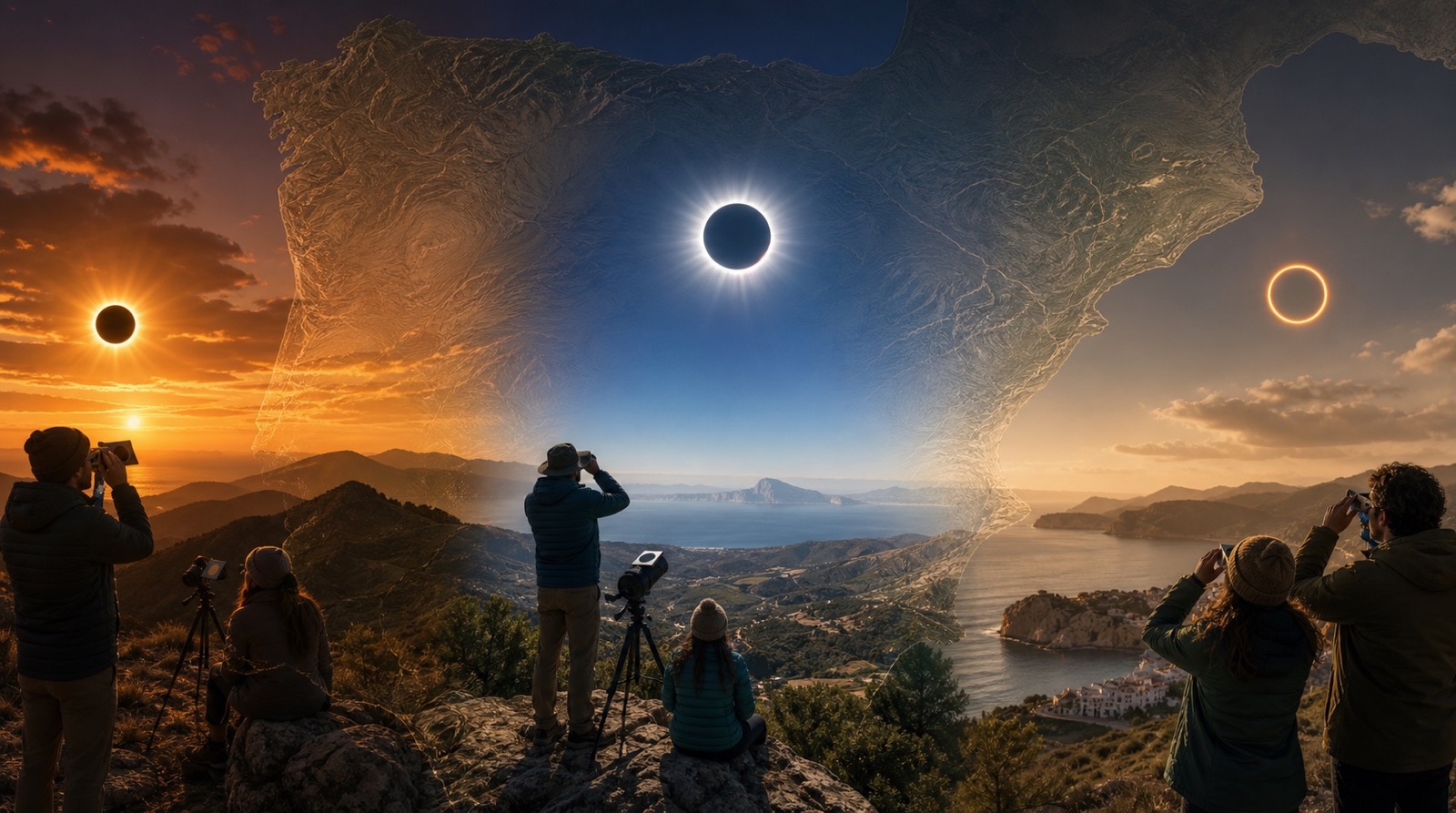
The Iberian Peninsula is about to receive a rare three-event sequence: totality on 12 August 2026, totality again on 2 August 2027, and annularity on 26 January 2028. It is tempting to treat them as three chances to repeat the same road trip. They are not. The official Spanish programme describes them as “two total eclipses and one annular eclipse”, but the practical differences go much further: the first is a low western sunset event, the second is a morning total eclipse in the far south, and the third is a winter ring of fire close to sunset.
1. One peninsula, three different geometries
An eclipse path is not a holiday itinerary. It is the footprint of a moving shadow or antumbra, and the useful part of that footprint changes with the event. The 2026 total path crosses Spain from west to east and reaches the country near sunset. The 2027 total path is concentrated around the Strait of Gibraltar and the southern edge of the peninsula, with totality during the morning. The 2028 annular path crosses from southwest to northeast late in the afternoon, when the Sun is again low.
That changes the question you ask of a viewing location. In 2026, a place inside the path can still fail because a western ridge hides the last minutes. In 2027, the same kind of western horizon may be irrelevant, while access, heat, shade, and a clear view toward the morning Sun become more important. In 2028, the ring never becomes safe to view without filtration, and winter cloud and low solar altitude become part of the plan from the start.
“Three unique astronomical events.”— IGN — Visible eclipses in Spain in 2026, 2027, and 2028
2. 2026: plan for a total eclipse at the western horizon
On 12 August 2026, totality crosses a broad band of northern and eastern Spain, including a route from Galicia across the peninsula toward the Balearic Islands. Spain sits near the end of the global path, so the event arrives with the Sun close to the western horizon. The result is an unusually cinematic eclipse, but also a strict line-of-sight problem: your viewing point needs a genuinely open western sector at the relevant azimuth, not merely a pin on a path map.
For this event, start with the horizon. Use the planner at the exact candidate coordinates, inspect the Sun’s altitude and azimuth at C2, totality, and C3, and compare that line of sight with the terrain profile. A ridge that looks modest on a road map can be decisive when the Sun is only a few degrees high. Keep a second location nearby, because a perfect path position is not useful if access, trees, buildings, or local relief close the view.
- Primary check: a clear western horizon at the exact event time.
- Best workflow: compare several nearby points, not just one city label.
- Backup logic: stay mobile enough to trade a small path advantage for a much clearer horizon.
3. 2027: plan for a morning total eclipse in the far south
On 2 August 2027, the totality band is a different shape and a different trip. IGN places it across the Strait of Gibraltar, covering southern Cádiz, parts of Málaga, and the cities of Ceuta and Melilla. The eclipse occurs in the morning, around 10:50 in peninsular Spanish time, and Ceuta is listed with the longest Spanish totality at 4 minutes 48 seconds.
This is not a sunset-horizon chase. Your plan should prioritise the southern path, reliable morning access, a comfortable position for a long partial phase, and an unobstructed view in the direction of the morning Sun. A higher Sun is generally easier to observe than the 2026 geometry, but it does not make location choice automatic: terrain, buildings, heat, crowds, road closures, and the exact boundary between total and partial still matter.
- Primary check: stay inside the narrow totality band in southern Iberia or at an explicitly verified location such as Ceuta or Melilla.
- Comfort check: plan shade, water, transport, and enough space for the long partial phases.
- Timing check: use observer-specific contacts rather than a headline time for the whole region.
4. 2028: plan for a winter ring of fire near sunset
On 26 January 2028, the trilogy changes category. The Moon will not fully cover the Sun; the path of annularity crosses Iberia from southwest to northeast and reaches much of Andalucía, southern Extremadura, Castilla-La Mancha, Madrid-area locations, Aragón, Murcia, Valencia, parts of Catalonia, and the western Balearic Islands. IGN describes the event as late afternoon and close to sunset, with low solar elevation making observation difficult.
The plan therefore combines the visibility problem of 2026 with a different safety rule. The low western horizon still matters, winter weather matters more, and no brief totality window permits unfiltered viewing. During every phase of an annular eclipse, the bright solar photosphere remains visible around the Moon. Filters stay on for eyes, cameras, binoculars, and telescopes throughout the event.
“There is no time when it is safe to look at the Sun without special-purpose eye protection.”— AAS — How to View a Solar Eclipse Safely
5. The same planner, three different questions
A good planning tool should not give the same advice for all three dates. Select the event, then ask what can fail at the chosen coordinates. For 2026 and 2028, the terrain horizon toward the setting Sun may be the deciding variable. For 2027, the path boundary and the practical conditions around a southern-morning site may matter more than a western ridge.
SunEclipses is useful here because it turns a regional eclipse path into an observer-specific investigation. Test the exact point, inspect the local contact times, check the relevant solar direction, and read the terrain profile as evidence rather than as a guarantee. The model does not know every tree, building, cloud, access restriction, or last-minute obstruction. It helps you discover which questions deserve an on-site check.
- 2026: path membership plus a low western horizon and a mobile sunset backup.
- 2027: southern path membership plus morning access, comfort, and a stable viewing position.
- 2028: annular-path membership plus winter weather margin, low-sun visibility, and filters for the entire event.
6. Build three plans, not one promise
The best way to enjoy the trilogy is to let each eclipse keep its own personality. Treat 2026 as a western-horizon geometry problem, 2027 as a southern-morning totality problem, and 2028 as a filtered winter sunset problem. The destination can be beautiful in all three years, but the correct place is the place that answers the event’s actual geometry.
Start early with a shortlist, compare exact coordinates, and keep a nearby alternative. Then revisit the result as the event approaches: weather forecasts improve, access changes, and the landscape can reveal details no broad map contains. Three eclipses deserve three honest plans. The planner can help you make each one specific.