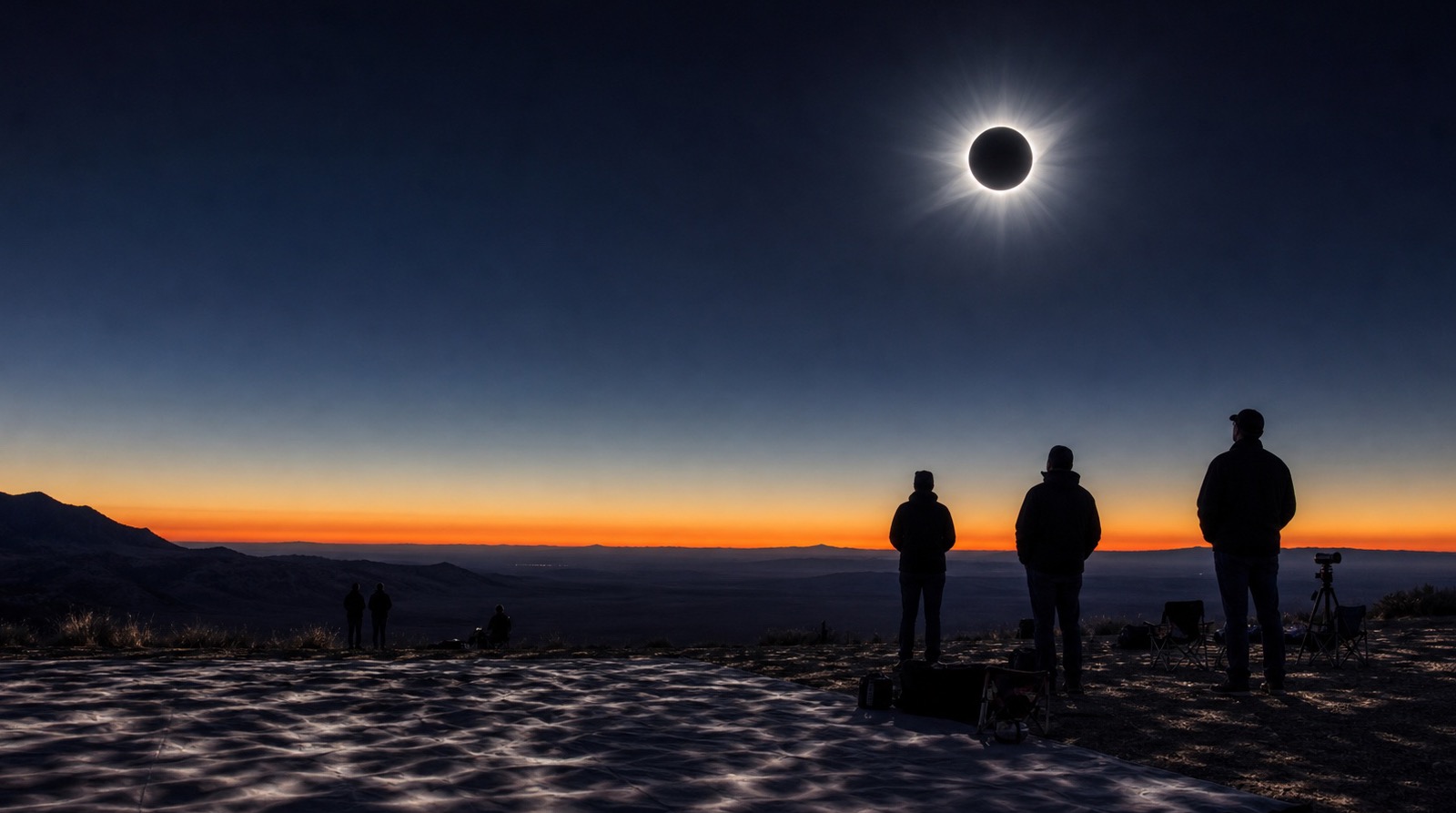
People often describe totality as a shock: the light seems to fall away, the horizon glows in every direction, the air feels different, and an ordinary landscape suddenly looks unreal. That reaction is not one mysterious effect. It is the result of several fast changes arriving together, while your eyes, body, attention, and expectations are still calibrated for daytime.
1. Your visual system loses its daylight reference
During the partial phase, the Sun can lose most of its area while the scene still feels recognisably like daytime. Your pupils gradually dilate and your visual system adapts as the illumination declines, which can hide how much light has actually disappeared. That slow adaptation is why a deep partial eclipse may feel less dramatic than its percentage suggests.
The final approach to totality is different. Once the Moon covers the last bright fraction of the photosphere, illumination drops by orders of magnitude in roughly the final minute. AAS measurements put typical totality around 5 lux in some conditions — comparable to civil twilight — but local brightness varies with the Sun’s altitude, weather, elevation, shadow width, and sky conditions. It is not simply “night in the middle of the day.”
Your brain is suddenly asked to interpret a world that is neither normal daylight nor night. The result can feel like a visual jolt: familiar objects remain in place, but their color, contrast, and depth cues have changed at once.
- Notice the sky’s color before looking at the eclipsed Sun: deep blue, silver, violet, or gray can all occur depending on conditions.
- Look at a familiar object such as a hand, a white shirt, or the ground; its color and contrast are useful sensory reference points.
- Do not interpret a dark sky as permission to look early: filters remain necessary until totality begins and after it ends.
“It’s more like the difference between twilight and daylight.”— AAS — How Dark Does It Get During a Total Solar Eclipse?
2. Sight expands beyond the Sun
A normal solar observation directs your attention toward one bright object. Totality breaks that habit. The black lunar disk and the pearly corona occupy the centre of your view, but the most powerful visual clues are often around the edges: a sunset-like glow in every direction, a darker band of sky near the Moon’s shadow, and a landscape that seems to have been placed under a dimmer switch.
The corona is visible only when the photosphere is completely hidden. Its streamers are not perfectly symmetrical, and the inner corona can look brighter and more structured than the outer extensions. Bright planets may appear, while stars are less predictable because the sky at totality is usually closer to twilight than to a moonless night.
Shadow bands add another layer of visual uncertainty. These faint, rapidly moving ripples may appear on pale ground, walls, or fabric just before or after totality. They can be difficult to see and photograph, which is part of the lesson: the most memorable detail may not be the one your camera records.
- Look at the horizon, not only at the eclipse: the 360-degree glow is one of totality’s most distinctive environmental effects.
- Scan the ground or a pale sheet for shadow bands during the last minute before and after totality.
- Give your eyes a few seconds to take in the corona before reaching for a camera.
“This feeble light creates a beautiful 360° sunrise/sunset glow around the horizon.”— AAS — Phenomena You’ll Experience at a Total or Annular Eclipse
3. Your body notices the atmosphere changing
As direct sunlight disappears, the ground and the air above it stop receiving the same energy. A noticeable temperature drop is possible, but it is not a guaranteed number: wind, humidity, cloud, shade, terrain, and the timing of the eclipse all matter. The temperature may continue falling briefly after totality and then begin to rise as sunlight returns.
Wind can also shift, strengthen, or fade as the surface heating pattern changes. These effects are local and variable, so treat your own thermometer and observations as measurements rather than assuming a dramatic result. The physical sensation may be subtle, but it arrives at the same time as the visual transformation, making it feel more intense.
That combination can produce goosebumps, a raised-hair sensation, or a sudden feeling of stillness. Those responses are human reactions to an extraordinary environment, not evidence that the eclipse is physically dangerous when observed with proper safety precautions.
- Bring a light layer even in warm weather; the perceived change can be noticeable and you may be standing still for a long time.
- If you want data, record temperature, wind direction, cloud cover, and time instead of relying on memory alone.
- Avoid promising a fixed temperature drop in your own report; conditions at two nearby sites can differ substantially.
“A total solar eclipse can be felt growing in the atmosphere.”— NASA — Looking Back on Looking Up: The 2024 Total Solar Eclipse
4. Sound, animals, and people change together
The falling light can change the soundscape as well as the view. Birds and insects may settle as though evening has arrived; some animals respond, while others do nothing obvious. The response is not a reliable scientific clock, but it is a memorable part of the environmental transition. Listen for the difference between the ordinary background and the sudden attention of a crowd.
Human behaviour is often the loudest signal. People stop talking, laugh, gasp, cheer, or make an involuntary sound when the diamond ring gives way to the corona. The reaction can feel contagious because everyone is responding to the same rapid change, while also realising that the moment will last only a short time.
This is why totality can feel social and solitary at once. You are sharing a physical environment with a group, but your eyes and brain are also trying to process more detail than they can hold. No single observer can look at the corona, horizon, shadows, animals, and crowd at the same time.
- Pause before totality and listen for birds, insects, wind, and the people around you.
- After totality, compare observations with others; different sightlines and attention choices produce genuinely different experiences.
- Accept that missing one phenomenon is normal. The event is larger than one person’s field of view.
“The ominous darkening in the sky can be seen and felt. Many have an intense physical reaction at this moment.”— AAS — The Total Solar Eclipse Experience
5. How to experience the sensory shock on purpose
You do not need specialised equipment to notice the sensory changes, but you do need a safe plan. Put your filters, contact times, clothing, water, and transport plan in place before the final minutes. If you are photographing, automate as much as possible so you can look away from the camera and experience the scene.
Use the contacts as a rhythm: C1 begins the gradual adaptation, the last minutes before C2 bring the fastest visual change, C2 opens totality, C3 reverses the sequence, and C4 closes the event. A short checklist helps you protect your eyes without turning the experience into a technical procedure.
Clouds may hide the corona, but darkness, temperature changes, animal behaviour, crowd reactions, and the approaching shadow can still be perceptible. Totality is something you experience with your whole environment, not only something you see through a clear gap in the clouds.
- Before C2: keep solar filters on, note the changing light, and look around the horizon.
- At C2: remove eye protection only inside totality and only after the bright photosphere is completely hidden.
- During totality: look at the corona, horizon, ground, and people before checking a screen.
- At C3: replace filters immediately before the bright photosphere returns to optical equipment or your direct view.
- After C4: write down what you felt and measured while the sequence is still fresh.