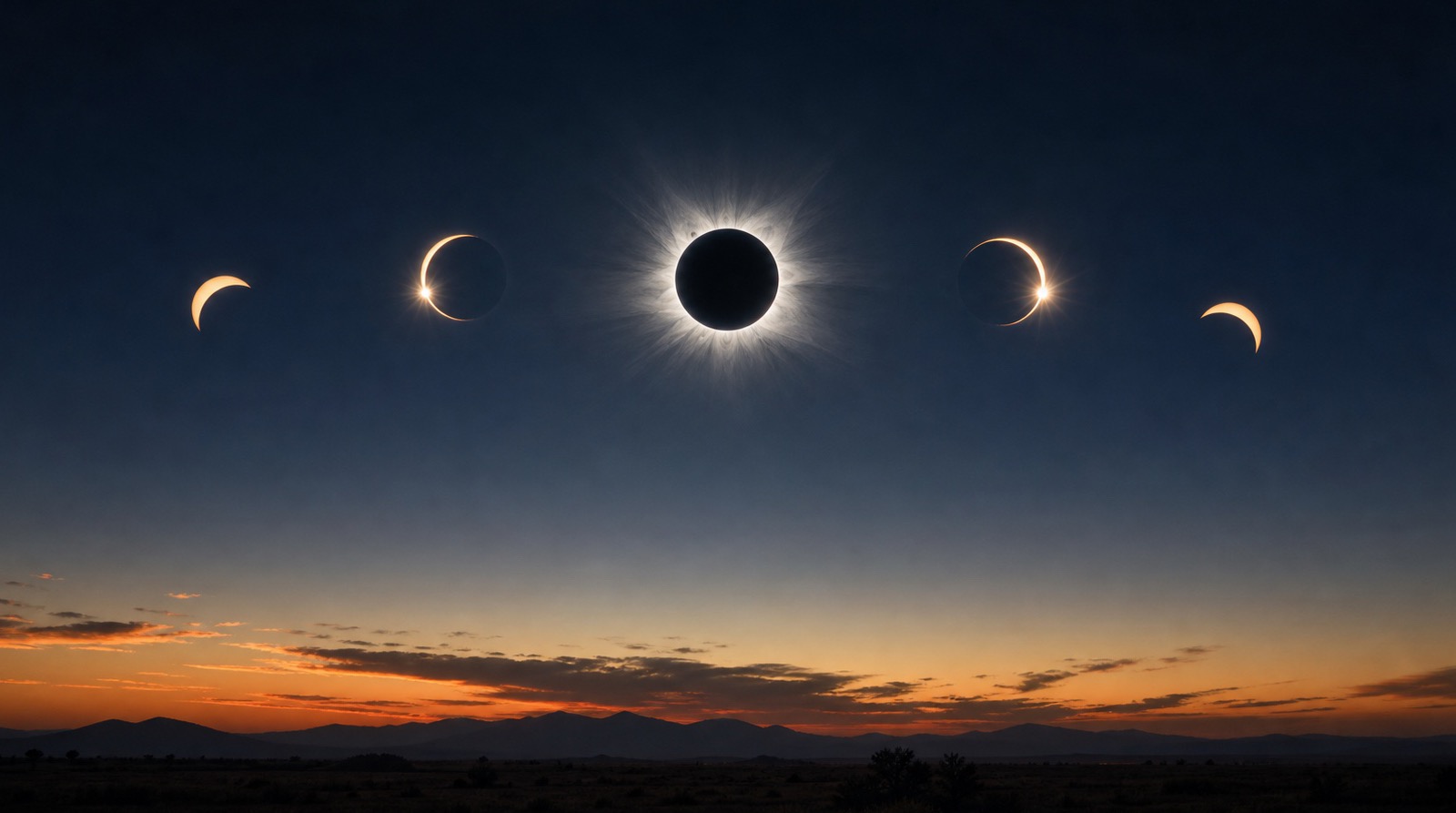
A total solar eclipse is not one event but a carefully timed sequence. The four contacts — C1, C2, C3, and C4 — mark the Moon’s progress across the Sun. Between them, the light changes, the landscape reacts, and a handful of fleeting phenomena appear for only seconds. If you know what to watch for, you can spend less time wondering what is happening and more time noticing it.
Contact 1 (C1): First Contact — The Eclipse Begins
C1 is the instant when the Moon’s disk first touches the Sun’s disk. The change is tiny: through a properly filtered viewer, the Sun appears to have acquired a small bite. Nothing dramatic happens to the landscape yet, but C1 starts the clock for the entire partial phase.
Record the exact C1 time for your location, then look away from the Sun and notice the ordinary world around you. Shadows, colors, wind, and temperature will change gradually rather than all at once. If you are photographing the event, C1 is the moment to begin a sequence of safely filtered partial-phase images.
- Use certified solar viewers for direct observation and keep a proper front-mounted solar filter on cameras, binoculars, and telescopes.
- Confirm that your filter is secure, undamaged, and designed for the specific optical equipment you are using.
- Write down C1, C2, maximum eclipse, C3, and C4 in local time before the event; contact times vary with your exact coordinates.
“The Moon touches the Sun and takes its first tiny nibble out of the solar disk.”— AAS — Phenomena You’ll Experience at a Total or Annular Eclipse
Contact 2 (C2): Second Contact — The Threshold of Totality
C2 is the instant totality begins. In the seconds before it, the remaining solar crescent narrows, Baily’s beads may flicker through lunar valleys, and the diamond ring can flash as the final bright point meets the corona. These moments are brief, so decide in advance whether you will watch with your eyes, photograph, or do both with a simple setup.
At the last bright bead, the photosphere is covered and the corona becomes visible. If you are observing by eye from inside the path of totality, this is the moment to remove eclipse glasses. If you are using a camera, binoculars, or telescope, follow the equipment maker’s safe-totality procedure and never improvise with an unfiltered optical system.
- Watch the western or eastern edge of the Moon’s silhouette for the last bead of sunlight and the diamond-ring flash.
- Listen as the crowd changes tone: the visual transition is fast, and the soundscape often changes with it.
- Keep the C2 time visible on a watch or spoken countdown so you do not remove filters early.
“The only safe way to look directly at the uneclipsed, partially eclipsed, or annularly eclipsed Sun is through special-purpose solar filters.”— AAS — How to View a Solar Eclipse Safely
Between C2 and C3: Totality — Look Up, Then Look Around
Totality is the interval between C2 and C3, when the Moon completely covers the Sun’s bright face. The corona appears as a pearly, uneven halo, with streamers that can extend farther on some sides than others. Bright prominences may glow pink or red along the lunar limb, while planets and bright stars can emerge in the darkened sky.
Do not spend the entire interval staring through a viewfinder. Look at the horizon for the 360-degree sunset glow, then look down for unusual shadows and back up at the corona. Shadow bands — faint, moving stripes of light and dark — may appear just before or after totality, but they are not guaranteed. A short mental checklist is more valuable than trying to capture everything.
Totality is also the only interval when the bright photosphere is fully hidden. That boundary is why a 99.99% partial eclipse is not equivalent to totality: the last bright sliver still overwhelms the much fainter corona and keeps filters necessary.
- First: take in the naked-eye view of the corona and the darkened landscape.
- Second: scan the horizon for sunset colors, the Moon’s shadow, and changes in the surroundings.
- Third: use a short, tested camera sequence if photography is part of your plan.
- Remember that totality duration is location-specific; use the planner’s C2-to-C3 interval rather than a generic countdown.
“From our unique perspective on Earth during a total solar eclipse, scientists can study the Sun’s corona…”— NASA — Science Soars During the August Total Solar Eclipse
Contact 3 (C3): Third Contact — Totality Ends
C3 arrives when the first bright point of the photosphere breaks through on the opposite edge of the Moon. The diamond ring appears again, but now the direction of the sequence is reversed: the corona recedes, the sky brightens rapidly, and the partial phase begins again.
This is the moment to replace solar filters before looking through any camera, binoculars, or telescope. For unaided observers, put eclipse glasses back on as soon as the bright photosphere returns. Do not let the excitement of the returning diamond ring turn into an unsafe extra glance.
- Watch for the first bead and the returning diamond ring at the edge of the Moon.
- Replace filters before the bright photosphere is visible through optical equipment.
- Make a quick note of what you saw during totality while the sequence is still fresh.
Contact 4 (C4): Fourth Contact — The Eclipse Is Over
C4 is the instant when the Moon completely leaves the Sun’s disk. The eclipse is finished, although the sky may remain subtly different for a while and the landscape may still be full of people comparing what they saw. C4 is a useful endpoint for timing, photography, and post-event notes.
After C4, pack optical equipment only after checking that every solar filter is secure or stored safely. Save your photos with the location, local time, lens, filter, and exposure notes. A sequence labelled from C1 through C4 is far more useful later than a folder full of unnamed files.
- Confirm that the final solar bite has disappeared before declaring C4 complete.
- Keep observing notes separate from impressions: record times, weather, cloud cover, and visible phenomena.
- Compare your experience with the planner’s predicted contacts, but treat local terrain, buildings, trees, and weather as real-world checks.